A backup
Helps you restore a site if something goes wrong.
Services · Web archiving
With web archiving you record how your organisation communicated online — including layout, content and links, exactly as visitors saw it. Ideal for government bodies and organisations that have to comply with the Dutch Archives Act or with strict compliance requirements.
01
We capture your website periodically, deliver reproducible WARC archives and store them securely within Europe. WARC is the file format in which national archives and libraries also preserve websites.
Helps you restore a site if something goes wrong.
Records irrefutably how your organisation communicated online — including layout, content and links, exactly as visitors saw it.
Hourly, daily, weekly, monthly or annually — aligned with your policy.
ISO 28500 archives, the same format that national archives and libraries use.
A fast static crawl or Browsertrix for JavaScript-rich sites and SPAs.
Checksums, a digital signature and an RFC 3161 timestamp per archive.
An EU data centre by default; if you wish, we connect your own S3 bucket.
A live replay portal and offline consultation with the ReplayWeb viewer.
02
For anyone who needs to be able to demonstrate what was online at a given moment.
In the Netherlands, government organisations are obliged to archive their websites under the Dutch Archives Act.
A good archive helps with Woo requests and internal supervision: you can demonstrate what was online at a given moment.
In financial services, healthcare and education too, transparency is often anchored in laws and regulations. There, the provability of publications carries a lot of weight.
03
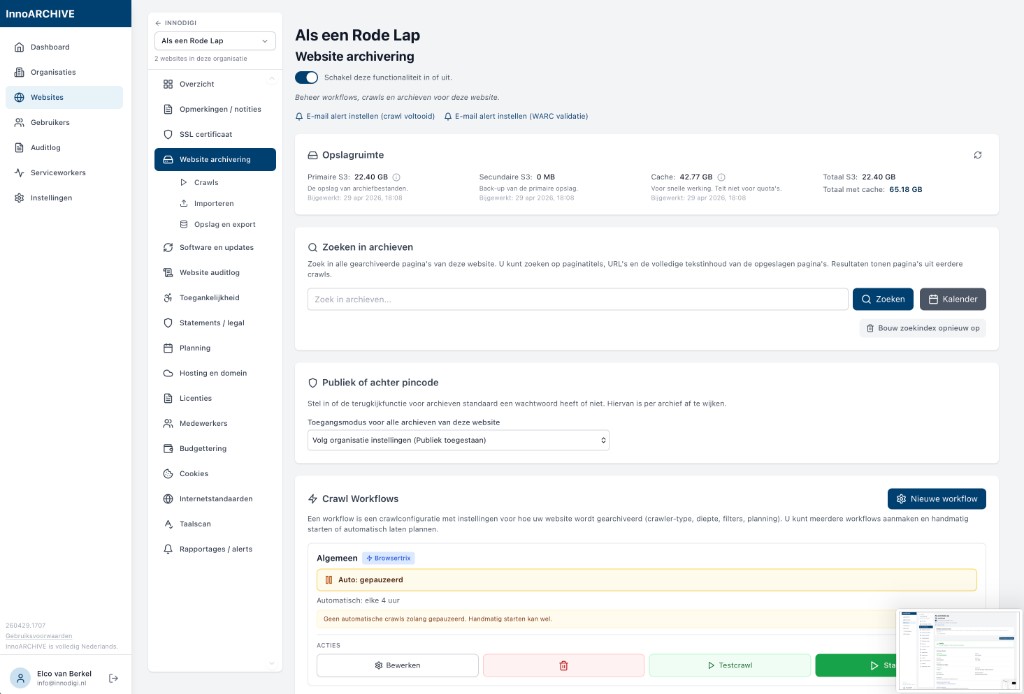
Once you give the go-ahead, we set up a workflow per website and go through five steps. After that the process repeats automatically at the agreed frequency.
Crawling? That means software automatically visits your website page by page and records everything, just like a visitor who clicks on everything.
04
Not every site is captured in the same way. For regular sites a fast, light static crawl is enough.
Sites with a lot of JavaScript or a single-page architecture (a site that behaves like a single app) we capture with Browsertrix. It drives a real browser and so also captures dynamic parts.
Not sure? We recommend Browsertrix as standard: it also captures menus, interactions and dynamic components that a static crawl misses. You can switch per website.
| Aspect | Static crawler | Browsertrix (recommended) |
|---|---|---|
| Technology | Fetches HTML and detects assets automatically | Headless Chromium that executes JavaScript in full |
| Speed & load | Fast and light — around 5 seconds per 6 pages | More thorough and heavier; renders every page like a browser |
| Suitable for | Regular HTML, WordPress and Drupal sites | JavaScript-rich sites and single-page applications (SPAs) |
| Used by | Simple, stable sites | Libraries and professional archivists |
06
We deliver every archive in WARC 1.1 (ISO 28500): the international standard for web archives, in which the original bytes of every page and asset are preserved. To make the integrity demonstrable, we seal every archive.
A checksum works like a fingerprint of a file. One deviating byte and you know: the checksums no longer match and the signature gives it away. That way you demonstrate irrefutably what was online at what moment.
Reproducibly recorded and cryptographically signed — from capture to transfer.
07
Privacy and digital sovereignty — keeping control of your own data — come first. By default we store archives in a European data centre (Scaleway, EU).
Would you like more control? Then we connect your own S3 bucket (online storage at AWS, MinIO or a compatible provider), or we store to several destinations at once for extra redundancy.
Subsequent crawls store only the changes incrementally, so storage stays manageable.
08
Per website you set exactly how and how often we capture, so the archive matches your archiving and retention policy.
From hourly to annually, or automatically via an API call after a change.
The whole site or sub-paths, with a configurable maximum click depth.
Include specific sections or exclude them using patterns.
Enable rendering per workflow for dynamic pages.
A first full capture, then efficient updates.
Start crawls and receive signals in your own systems.
09
Does an archive eventually have to go to an e-Depot? That takes place via dual signing. Both you and we sign the manifest; without your signature nothing can be transferred or deleted. That way you always keep a built-in right of veto.
A deletion too — for example on the basis of the GDPR — is a separate, signed and logged action. That way an irrefutable trail of what happened remains.
On transfer, we supply the metadata MDTO-compliant — the standard Metagegevens voor Duurzaam Toegankelijke Overheidsinformatie of the Dutch National Archives — so that the archive can be admitted directly into a government e-Depot.
10
Alongside the WARC delivery we provide a replay portal that you place on your own site. Visitors choose a year, month and day and see the site exactly as it looked at the time — as if they were travelling back in time.
Journalists and researchers can also download the WARC files and open them in their own viewer. Would you like to see how that works in practice?
Archives can also be viewed without an internet connection using the ReplayWeb viewer — handy for audits, case files and situations without a live connection. You open the WARC file locally and navigate through the archived site just as before.
11
After your request we take stock of the site, estimate storage and computing time and you receive a quotation. Once you agree, we start within a few days.
Usually no CMS access is needed: we crawl the public site as a visitor sees it.
12
Is your question not listed? Feel free to call or email, we are happy to think along.
Call 073 234 0321A backup helps you restore a site. A web archive records irrefutably how a site looked at a particular moment — including layout, content and links — in the WARC format, complete with checksums and a digital signature. It is intended as evidence and for compliance, not as a restore point.
Usually not. We crawl the public site as a visitor sees it. Only for restricted sections or heavy applications do we make additional arrangements.
From hourly to annually, or automatically via an API call after a change. We align the frequency with your archiving and retention policy.
WARC (ISO 28500) is the international standard for web archives, used by national libraries and archives. It preserves the original bytes of every page and asset, so the archive is reproducible and future-proof.
Every archive gets a manifest with SHA-256 and SHA-512 checksums, a GPG signature and an RFC 3161 timestamp that is anchored externally via OpenTimestamps. A single changed byte makes that immediately visible.
By default in a European data centre (Scaleway, EU). If you prefer, we connect your own S3 bucket (AWS, MinIO or compatible) or store to several destinations at once for extra redundancy.
Yes. Transfer and deletion take place via dual signing: both you and we sign the manifest. Without your signature nothing can be transferred or deleted — a built-in right of veto. We supply the metadata in MDTO-compliant form (Metagegevens voor Duurzaam Toegankelijke Overheidsinformatie, the Dutch government metadata standard), so the archive can be admitted into a government e-Depot.
Government organisations are obliged to archive their websites. Our reproducible WARC archives, timestamps and the replay portal help you meet that obligation — and Woo requests under the Dutch Open Government Act — demonstrably. We are happy to think along about frequency and retention.
Yes, optionally. We provide a replay portal that you place on your own site; visitors choose a year, month and day. Researchers and journalists can also download WARC files and open them offline with the ReplayWeb viewer.
Adjust the site so that it reads most comfortably for you.
When read aloud is on, text blocks on the page are outlined. Click or tab to a block and activate it (click, Enter or space) to hear the text.
We respond quickly and personally.
Welcome
InnoDIGI
Digital solutions with character · Rosmalen
05
Social media archiving
Online communication does not stop at your website. Your presence on social media is captured periodically too. Handy for government bodies and organisations that also have to preserve their posts on social channels demonstrably, for example for the Dutch Archives Act or Woo requests.
We capture the public channels — in line with what each platform allows — and deliver them in the same reproducible archive, with checksums and a timestamp.
Facebook
Public pages, posts and comments as visitors saw them.
Instagram
Public profiles, photos and reels from your channel.
Mastodon
Public toots and profiles from the fediverse.
Bluesky
Public posts and profiles from the AT Protocol.